EN
EN 


 If you have any questions, you can contact our managers in any convenient way for you.
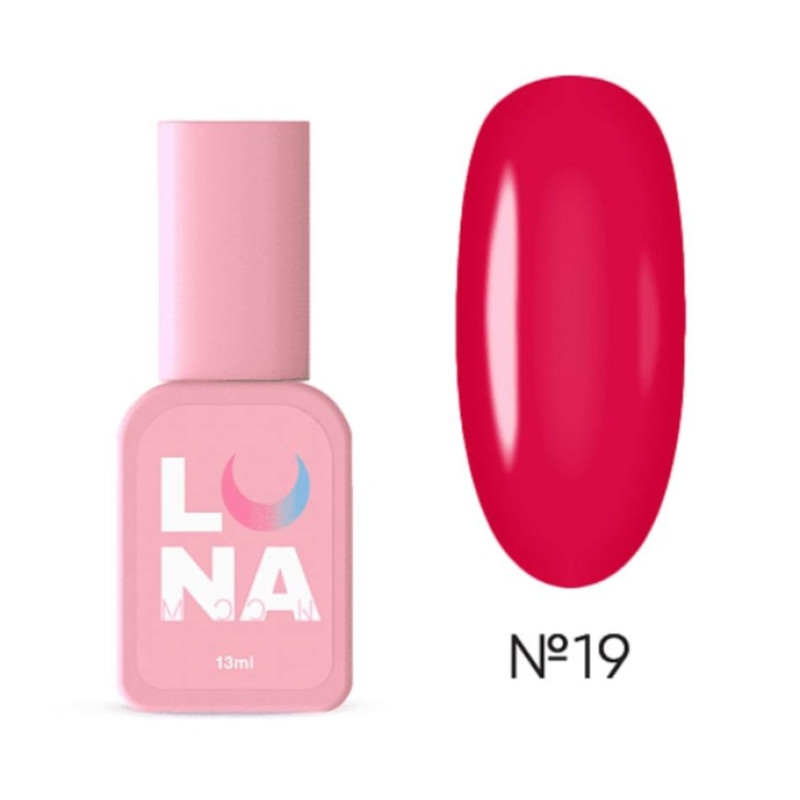
Acrylic gel LUNA Light No. 19, 13 ml
330.00грн
264.00грн
- Brand: LUNA
- Product Code: 00-00003554
- Availability: In Stock
Light Acrygel is a liquid gel that has the consistency of a base. It is used to strengthen a weak nail plate. Fast in repairing cracks, chips, corners of the nail.
Features:
- They dry completely.
- Medium density.
- Acid-free, medium consistency.
- Average pigmentation, covers the free edge.
- Suitable only for strengthening the nail.
- Not suitable for full build-up.
- Medium-hard.
- It has good depreciation.
- Does not shrink.
- The thickness on the end should be 1 mm, not less.
- When strengthening with this gel, you need to file the natural nail.
- Rubber base lining is required.
- Thixotropic — becomes thinner in work with brush movements.
- You can additionally heat it to make the gel thinner.
Choose liquid acrylic if:
— It is more convenient for you to do alignment with bases. The convenient format in the form of a usual bottle with a brush allows masters to work in the usual leveling technique.
— The client's natural nails are long. When leveling on such nails, the layer of material should be thicker than on short ones, otherwise the nails will simply break. Since the base cannot be applied in a thick layer, otherwise burns, allergies, onycholysis and other problems may occur, liquid acryl gel, thanks to its chemical composition, is well polymerized and can be applied in a thicker layer.
— If your client is allergic. Materials based on oligomers and copolymers are less allergic than soft bases based on monomers.
— There is no opportunity to learn more complex technology of working with gels. Liquid acrylic gel does not require additional training! Even a beginner can handle it.— There is a need to strengthen the nails, and the bases do not suit the client for some reason, the coating peels off, and the nails break. Liquid acrylic gel has reliable adhesion to the nail plate. In addition, it is stronger compared to bases and is suitable for almost any nails. This is especially important for long nails!
- It is necessary to strengthen small natural nails. It is much easier to do this with liquid acrigel than with ordinary gels and polygels. Because its mixture allows you to apply a coating with a thin layer even on tiny nails. And thicker products can create
extra volume and the nails will be very thick.
Strengthening:
1. Removal.
2. We do not dust the shape of the nail. Or we leave a spare 2 mm of length, which we dust and take away after leveling.
3. With a file of 220 grit, file the nail from above without strong pressure, lifting the scales of the nail plate. Or use a buff of 100 grit.
4. Manicure.
5. If you work with removers, you need to wash your hands with soap and water after using them.
6. Nail degreasing. It is necessary to make two approaches. We use 4 napkins. One napkin for 5 fingers. The first approach is to wipe the surface of the nail. The second approach is to take an orange stick, put on a napkin and wipe everything in the cuticle area and in the sinuses.
7. Dehydrator (optional).
8. We use the primer as desired. But if the base for the substrate has sufficient acidity, then a primer is not needed.
9. Lining with Rubber base Lunamoon. Best applied with a flat gel brush. Movements should be rubbing. It is important to draw all sinuses of the nail. Dry for 30 seconds.
10. Wipe off stickiness.
11. Alignment.Dry in a lamp for 120 seconds.
12. Form dusting after alignment. This is necessary so that a thickness is formed on the end that will hold the free edge.
13. It is necessary to file the natural nail, for better wearability, if this is not done, there will be peeling on the free edge of the nail.
14. After sawing, we wipe off the stickiness.
15. If necessary, cover with gel varnish.
16. Apply top coat and dry for 120 seconds. After drying, do not wipe with anything, because the shine may be lost.
Features:
- They dry completely.
- Medium density.
- Acid-free, medium consistency.
- Average pigmentation, covers the free edge.
- Suitable only for strengthening the nail.
- Not suitable for full build-up.
- Medium-hard.
- It has good depreciation.
- Does not shrink.
- The thickness on the end should be 1 mm, not less.
- When strengthening with this gel, you need to file the natural nail.
- Rubber base lining is required.
- Thixotropic — becomes thinner in work with brush movements.
- You can additionally heat it to make the gel thinner.
Choose liquid acrylic if:
— It is more convenient for you to do alignment with bases. The convenient format in the form of a usual bottle with a brush allows masters to work in the usual leveling technique.
— The client's natural nails are long. When leveling on such nails, the layer of material should be thicker than on short ones, otherwise the nails will simply break. Since the base cannot be applied in a thick layer, otherwise burns, allergies, onycholysis and other problems may occur, liquid acryl gel, thanks to its chemical composition, is well polymerized and can be applied in a thicker layer.
— If your client is allergic. Materials based on oligomers and copolymers are less allergic than soft bases based on monomers.
— There is no opportunity to learn more complex technology of working with gels. Liquid acrylic gel does not require additional training! Even a beginner can handle it.— There is a need to strengthen the nails, and the bases do not suit the client for some reason, the coating peels off, and the nails break. Liquid acrylic gel has reliable adhesion to the nail plate. In addition, it is stronger compared to bases and is suitable for almost any nails. This is especially important for long nails!
- It is necessary to strengthen small natural nails. It is much easier to do this with liquid acrigel than with ordinary gels and polygels. Because its mixture allows you to apply a coating with a thin layer even on tiny nails. And thicker products can create
extra volume and the nails will be very thick.
Strengthening:
1. Removal.
2. We do not dust the shape of the nail. Or we leave a spare 2 mm of length, which we dust and take away after leveling.
3. With a file of 220 grit, file the nail from above without strong pressure, lifting the scales of the nail plate. Or use a buff of 100 grit.
4. Manicure.
5. If you work with removers, you need to wash your hands with soap and water after using them.
6. Nail degreasing. It is necessary to make two approaches. We use 4 napkins. One napkin for 5 fingers. The first approach is to wipe the surface of the nail. The second approach is to take an orange stick, put on a napkin and wipe everything in the cuticle area and in the sinuses.
7. Dehydrator (optional).
8. We use the primer as desired. But if the base for the substrate has sufficient acidity, then a primer is not needed.
9. Lining with Rubber base Lunamoon. Best applied with a flat gel brush. Movements should be rubbing. It is important to draw all sinuses of the nail. Dry for 30 seconds.
10. Wipe off stickiness.
11. Alignment.Dry in a lamp for 120 seconds.
12. Form dusting after alignment. This is necessary so that a thickness is formed on the end that will hold the free edge.
13. It is necessary to file the natural nail, for better wearability, if this is not done, there will be peeling on the free edge of the nail.
14. After sawing, we wipe off the stickiness.
15. If necessary, cover with gel varnish.
16. Apply top coat and dry for 120 seconds. After drying, do not wipe with anything, because the shine may be lost.
| Characteristics | |
|---|---|
| Volume, ml | 13 |